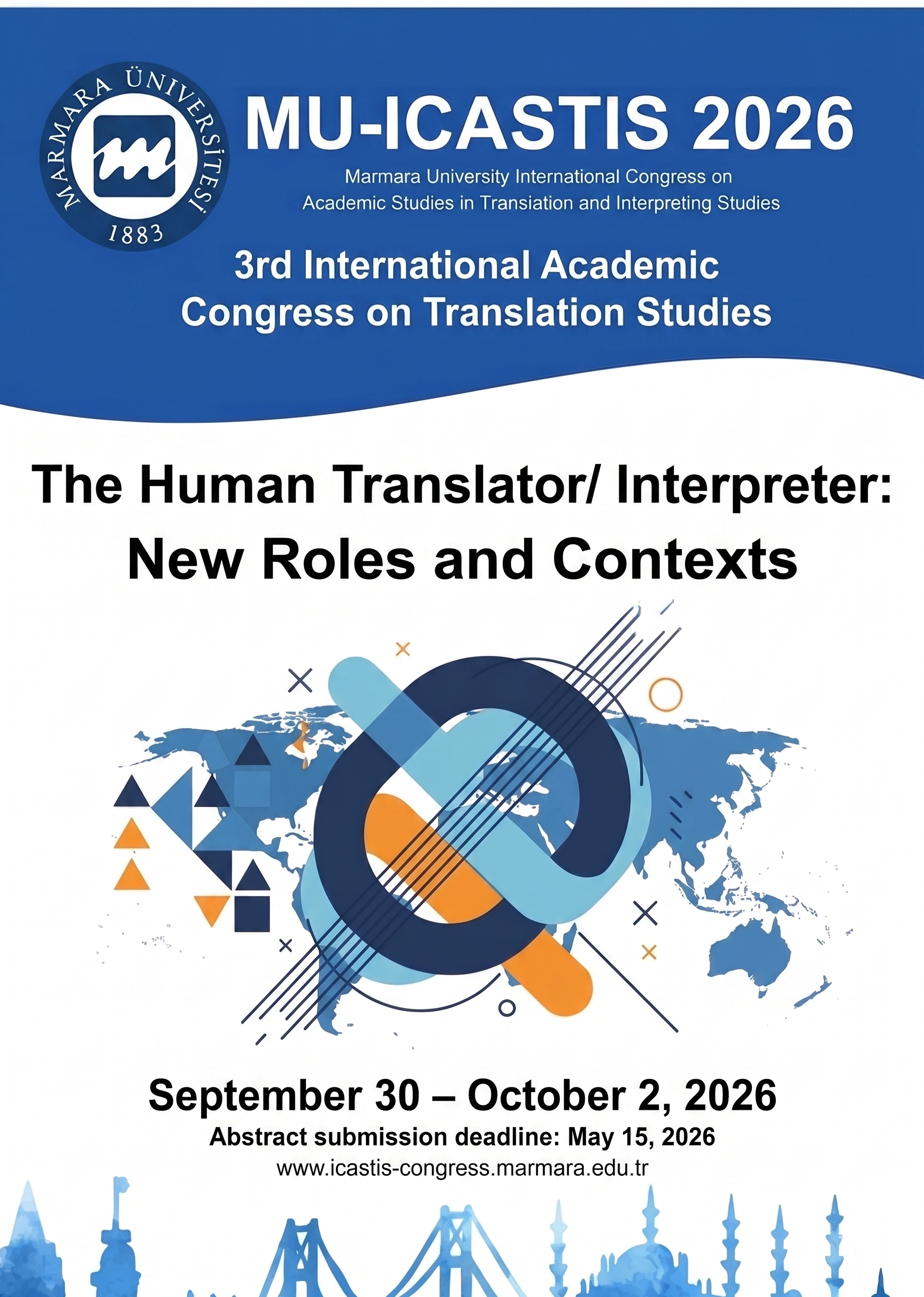
ICASTIS 2026
The Human Translator/Interpreter : New Roles and Contexts
Marmara University, Istanbul - September 30 - October 2, 2026
In the twenty-first century, the translation profession is undergoing a profound redefinition, shaped by artificial intelligence (AI), digitalization, crisis environments, intercultural interactions, new modes of communication, processes of professionalization, and social transformations.
Since James Holmes first questioned the name and nature of the discipline, the definition and scope of translation -as well as the tasks and competencies expected of translators- have been continuously revised through new theoretical turns, frameworks, and shifts in practice, particularly within the core paradigms of the social sciences.
While debates in Translation Studies are currently dominated by questions surrounding AI and technology, particularly in light of posthumanist perspectives, the challenges facing the discipline extend well beyond digitalization. Neglecting long-standing issues and discussions in the field risks producing troubling consequences for the discipline as a whole.
Following its first edition in 2022 and second in 2024 at Bolu Abant İzzet Baysal University, the third International Congress on Academic Translation and Interpreting Studies (ICASTIS) will be hosted by Marmara University in Istanbul from 30 September to 2 October 2026. Against this backdrop, the congress will focus on the “human translator,” a figure who has, throughout history, assumed multiple roles as cultural ambassador, communication specialist, intermediary, guide, and social planner, not only within digitalized settings and contexts but across all areas of translation.
Rather than positioning “human” and “artificial intelligence” as opposing poles, ICASTIS 2026 adopts a descriptive perspective aimed at identifying key issues and proposing solutions.
We consider it more productive to approach technology not as either a panacea or a threat, but as a phenomenon that necessitates new contexts, working environments, modes of communication, and relational dynamics. The concept of the “human translator” should therefore be understood not merely as a product of technological change, but also of social, cultural, ideological, and educational contexts.
ICASTIS 2026 aims to bring the foundational theoretical knowledge of Translation Studies into dialogue with contemporary concerns such as trauma-informed translation in crisis communication, ecology-oriented research and sustainable translation, competence architecture in translator education, human-in-the-loop (HITL) processes in human–machine interaction, and feminist retranslations. Through these subthemes, the congress seeks to critically examine the evolving roles and competencies of the human translator.
Proposals addressing other current debates and issues in Translation Studies that make a scholarly contribution to the field are also welcome and will undergo double-blind peer review.
Please click the link below for the Application Form:
https://icastis-kongre.marmara.edu.tr/basvuru-sayfasi
SUBTHEMES
- Translation Education
- Translation Technologies
- Interpreting
- Audiovisual Translation and Communication
- Accessible Communication
- Translation Project Management
- Translation Sociology and History
- Feminism, Eco-criticism, and Translation Criticism
- Ethics and Human Rights in Translation
- Translator Health and Wellbeing
- Policy and Governance
- Professionalization in Translation
- Translation Theory
- Literary Translation and Cultural Studies
- Technical and Specialized Translation
- Sustainability and Environmental Approaches
PUBLICATION OPPORTUNITIES:
Participants who wish to develop their conference papers into full-length journal articles after the congress will have the opportunity to submit their work for publication in the;
* Special Issue of the Marmara University Motif Journal
* Special Issue of the Alma Mater – Journal of Interdisciplinary Cultural Studies (https://almamaterjics.com/en).
* Also individual submissions to the Journal of Marmara Turkic Studies (Marmara Türkiyat Araştırmaları Dergisi) will also be considered for publication in forthcoming issues (https://dergipark.org.tr/tr/pub/mtad).
Submissions will undergo a standard double-blind peer review process, and manuscripts deemed suitable by the reviewers and editorial boards will be considered for publication in these special issues.
In addition, participants who prefer to publish their work in the online conference proceedings may submit their papers for inclusion in the official ICASTIS Proceedings Book, subject to editorial evaluation.
This page updated by ICASTIS (III. Uluslararası Akademik Çeviribilim Çalışmaları Kongresi) on 30.06.2026 22:48:22


